

How Long Does It Take for Google Maps Visibility to Change? Realistic Expectations
How long do Google Maps rankings take? No exact timeline exists; we cover changes that show up fast, work that takes time, and how to measure progress.
By BadePlus

Images are AI-generated.
You've edited your profile, added photos and started replying to reviews; now the question on your mind is clear: how long do Google Maps rankings take, and when will you see results? The honest answer: there's no exact timeline, and no one can realistically give you a specific date. But knowing which changes show up relatively quickly, which build up over time, and how to measure progress helps you set the right expectations.
The timing and ranking relationships in this article are not rules but observations commonly seen in the field. Google always decides rankings. The same answer applies to how long local search engine optimization (SEO) takes.
Why can't an exact timeline be given?
Google says local results rest mainly on three factors: relevance (how well your profile matches the search), distance (how far the searcher is from your business) and prominence (how well known your business is; review count and ratings are part of this). Google's tips to improve your local ranking page also states that the details of the evaluation aren't disclosed, to keep the system fair, and that you can't request or pay for a better ranking.
This framework explains why timing can't be stated clearly:
- Your competitors change too. While you improve your profile, nearby businesses also get reviews, add photos and update their information. Your ranking doesn't depend on your work alone.
- Every search is different. The same keyword can give different results when searched from two ends of a neighborhood. Checking from a single point and saying "my ranking hasn't changed" is misleading.
- Google updates its systems. Evaluation methods change over time, and these changes aren't always announced in advance.
- Starting points differ. A profile that has collected reviews for years and a newly opened one won't respond the same way to the same work.
Changes that show up quickly
The effect of some edits can appear relatively early once Google publishes them. These are usually tasks that fix a gap or an error in the profile:
- Correcting wrong information: Business hours, phone number, address or website.
- Filling in missing fields: Description, services and attributes.
- Correcting the primary category: The category that truly describes your business. Changing the category often, however, can backfire.
- Verification: Verifying an unverified profile.
Observation: Corrected information may make a difference earlier than other work in the searches it directly relates to, for example searches matching the correct category or "open now" searches. This isn't a rule; the same fix may have a clear effect on one profile and go unnoticed on another.

Work that takes time
Tasks that affect prominence work cumulatively and aren't done once and finished:
- Reviews and replies: Reviews that arrive steadily and naturally, and your replies to them. A steady flow spread over time, rather than many reviews collected in a short burst, is more natural and avoids sudden spikes Google may find unusual.
- Photos and posts: Regular content showing that your business is current and active.
- Your website and online presence: Google also weighs information across the web when evaluating prominence. Links to your site and mentions of your business in other sources build up over time.
- Consistent information: Your name, address and phone number written the same way everywhere.

Measuring progress
Even if you can't know the timing in advance, you can measure progress. The right measurement answers "is it working?" with data, not guesswork.
Measure across an area, not from one point
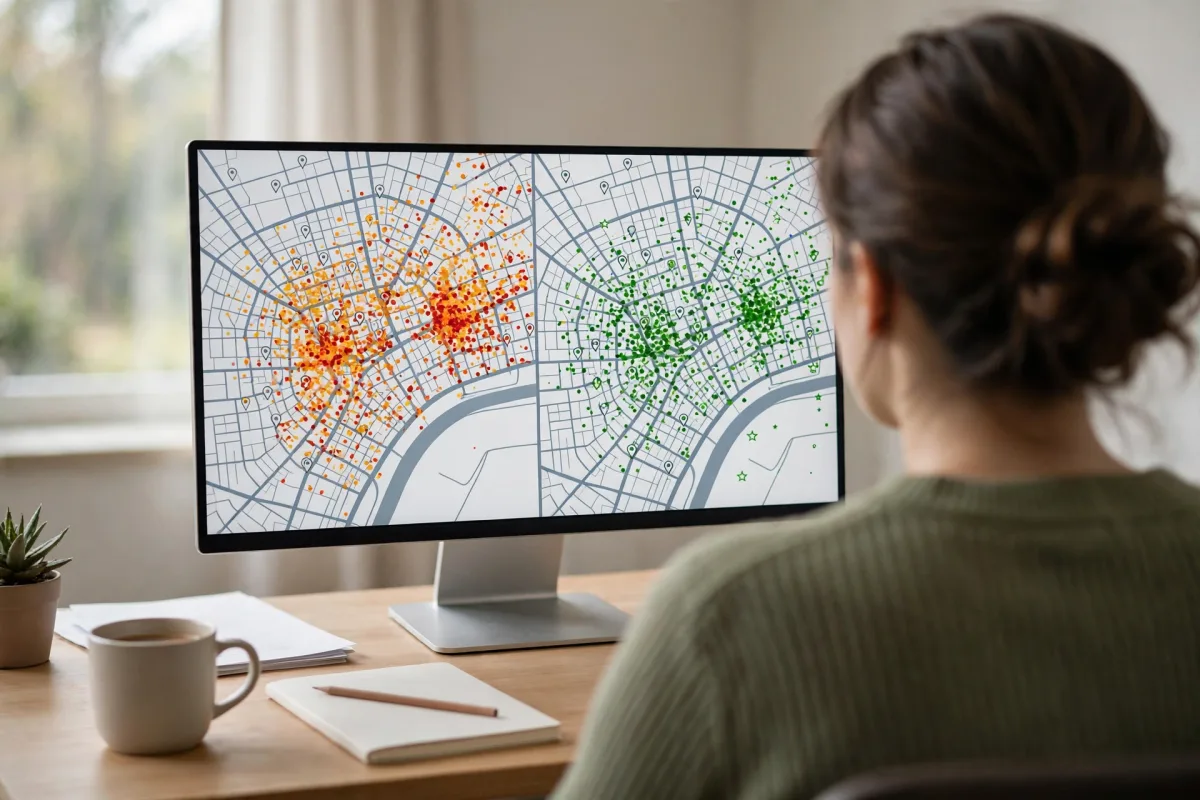
A search you run on your phone inside your shop shows only the result at that spot. Your customers search from different streets and neighborhoods. So measuring rankings from points on a grid spread around your business gives a more realistic picture. A heat map that shows this measurement in colors reveals at a glance where you're visible and where you're weak.
Repeat the measurement under the same conditions
- Track the same keywords; don't change the keyword list often.
- Measure at similar times of day. In our observation, results for searches made while the business is closed can look different from those during opening hours.
- Look at the average of several measurements, not the result of one. A single scan can make daily fluctuation look like real change.
Keep a log
Note what you changed on which day: the day you updated the description, the photos you added, the information you corrected. When you see your ranking move, this log is the most reliable way to understand why. Google Business Profile's own performance data, such as how many times your profile was viewed in searches and the number of calls and direction requests, also complements rankings.
If you want to measure this regularly, BadePlus's map rank tracking feature scans your chosen keywords on a 7×7, 9×9 or 13×13 point grid and shows the result on a heat map, so you track change across the whole area rather than through a single search.
Patience and routine
Local visibility work is maintenance, not a campaign. For a realistic approach:
- Set up a weekly routine. Replies to new reviews, a post, photos when needed. Small but regular work is healthier than occasional big pushes.
- Spread changes over time. Changing many details on the same day can lengthen the review and makes it harder to read which change had which effect.
- Stay away from shortcuts. Adding keywords or a city to your business name, inflating numbers with fake reviews or using an address that isn't real breaks Google's rules and can get the profile suspended. A suspension halts long-running work in an instant; we cover the causes and prevention in our article Has your Google Business Profile been suspended?
- Compare the right way. Compare yourself not with the previous measurement but with the average over a longer period.
- Keep the profile's foundation solid. The correct category, complete information, real photos and regular review replies are the ground every measurement stands on. If this foundation is weak, interpreting the results gets harder too.
Frequently asked questions
When will my ranking go up?
No one can say for sure; Google decides rankings. If someone promises you a specific ranking within a specific time, question what that promise is based on.
I made changes but my ranking dropped. Why?
Rankings move with many factors: competitors' work, Google's updates and the spot where you measure all affect the result. If the drop lasts across several measurements, check your most recent change and your profile's status; for a step-by-step list, see our article What to check first if your Google Maps ranking dropped.
What should a newly opened business expect?
On a new profile, reviews and recognition start from zero. Early on, it's important to keep the basic information complete and work steadily; there's no definite answer to how long it will take.
Summary
- No exact timeline can be given for how long Google Maps rankings take; the decision is Google's.
- Correcting wrong information and filling in missing fields may make a difference relatively early after publication; this is an observation, not a rule.
- Work such as reviews, photos, posts and recognition has a cumulative and uneven effect.
- Measure progress across an area rather than from one point, under the same conditions and with averages; log the changes you make.
- Shortcuts can get the profile suspended; regular maintenance that follows the rules is the safest path.